
The Mushroom Picker Problem
How we end up in lives we don’t recognize — and what to do when the trail runs cold

Before we get into today’s post, a quick ask:
I’ve been noticing a pattern: the smartest people I know are often the most stuck. Not because they lack options, but because they overthink them, second-guess themselves, or quietly sabotage the moves they know they should make.
Turns out, knowing what to do and actually doing it are hilariously different skills.
I’m working on a diagnostic session to help people see what’s actually blocking them (usually not what they think). But I need 3-5 guinea pigs to test what works in real life vs. what just looks good on paper.
The deal: 60-90 minutes, free. We play detective, get creative, figure out where you’re stuck and what the smallest viable next move is. You get clarity. I get brutally honest feedback.
If you’re sitting on a decision, stuck between options, or mysteriously unable to move on something that matters - drop me a message. Let’s figure it out.
OK- back to the show!
Here’s something I see so often it’s almost a rule.
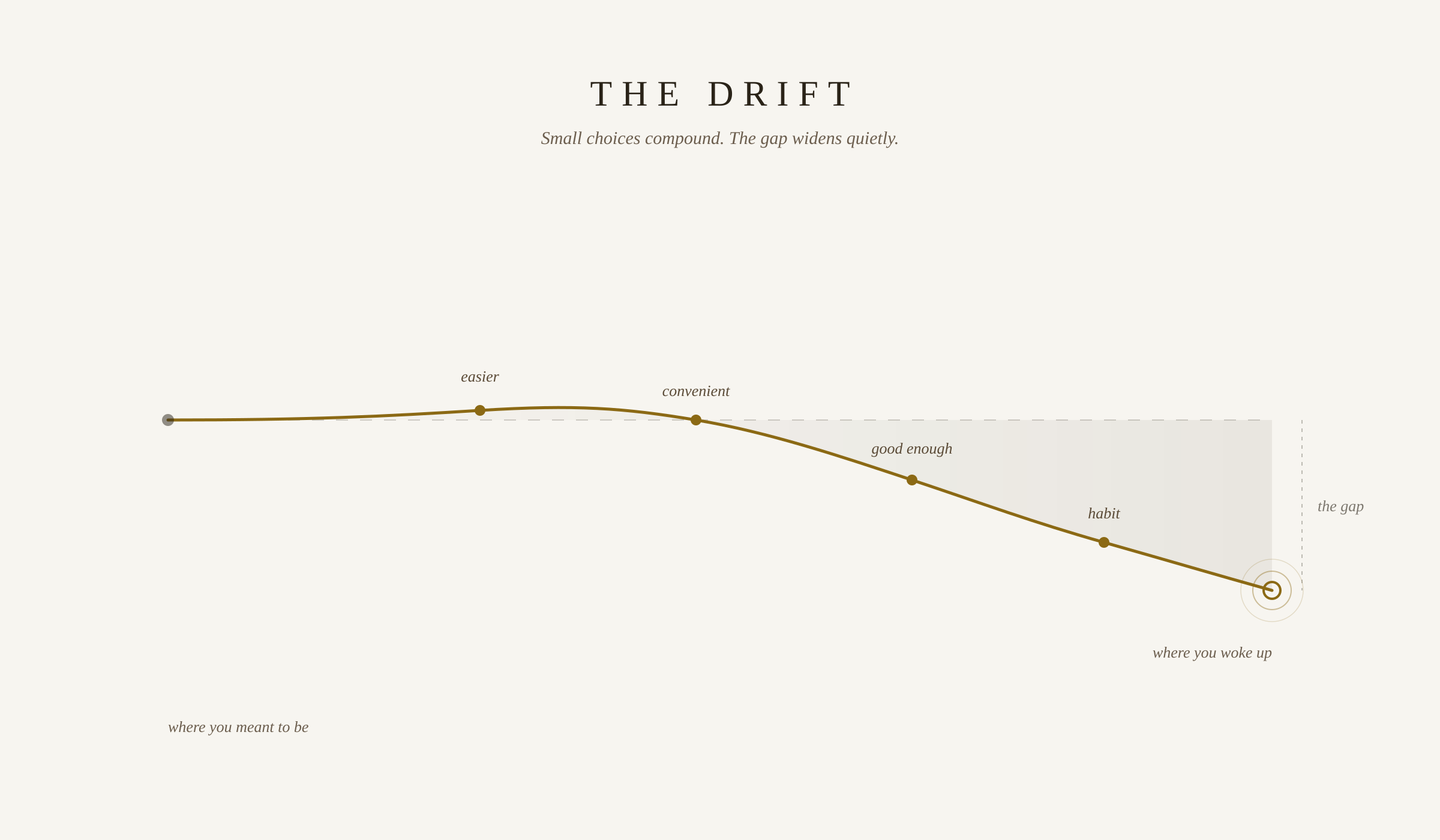
We make decisions, but we don’t always make them deliberately. We drift. We patch things. We apply duct tape solutions to situations that seem temporary and then forget to revisit them. The tape holds, life goes on, and one day you look up and realize the temporary became permanent — and the permanent became your life.
I’m not saying this to make you feel bad. It would be almost impossible to avoid entirely. Some drifting is inevitable, even healthy. You can’t be deliberate about everything all the time — and honestly, you shouldn’t try. So there’s no point in beating yourself up about how you got here. That’s not the work.
The work begins at a different moment.
It usually starts with a feeling. Something no longer fits. You wake up — and I mean really wake up, like from a trance — and look around. How did this become my life? Who even is this person I’ve become? You don’t recognize yourself. Or maybe you do, and what you recognize is someone who settled without realizing they were settling.
I’ve heard this more times than I can count. It’s very common around midlife, but it can hit at any moment. What it takes is some form of crisis — bigger or smaller — that slows you down enough to actually see. The crisis acts as a forcing function. It grinds your momentum to a halt, raises the stakes, and makes you look at what you’ve been avoiding, or what you simply never noticed because you were too busy moving.
And here’s what’s important to understand about how you got here.
When you’re younger, many of your choices aren’t even really your choices. You construct certain tools to navigate the world as you understand it. You find solutions that seem to work — they get you what you need at the time — and then those solutions harden. They become defaults. That’s how beliefs form, patterns crystallize, identity takes shape. The story you tell yourself about yourself, your position in life, what you’re capable of and what you’re not — it all gets built from these early experiments that were never meant to be permanent.
And here’s the thing about boldness when you’re young: it’s not that you’re actually braver. It’s that the stakes are lower.
Boldness at 20 is a very different animal than boldness at 45. When you’re 20, you can choose wrong and still feel like there’s time to fix it, change course, try again. So you take risks that look daring from the outside but actually carry less weight. Plus, you have less life experience, which means less awareness of consequences.
So even if you look back and don’t like what you chose — please hear this — it was the best choice you could have made at the time. Nobody makes deliberately stupid decisions. We always choose to the best of our knowledge, understanding, and beliefs. That’s not a cop-out. That’s self-compassion. And you’re going to need it for what comes next.
The sneakiest changes aren’t the big dramatic ones. They’re the ones that revolve around inertia and entropy.
Those duct tape solutions that work well enough for a while, the ones you don’t see as very important, the ones you think you’ll always be able to fix later — they quietly become your life. It’s the Slight Edge phenomenon: a tiny drift, positive or negative, compounding over time while you’re too busy to notice.
We optimize for what we value most at the time. Maybe at 23 you optimize for freedom and pick a job that funds your skateboarding habit. You don’t need much, and it works. Then you’re 35 and you realize you can’t buy a home, can’t start a family, because that optimization locked you into a track you never consciously chose. The rethinking begins.
If you’re not paying attention, you go slightly off course bit by bit. And the thing about drifting is that it doesn’t announce itself. Something you repeat out of convenience becomes habit. Habit builds gravity. And gravity is very hard to escape.
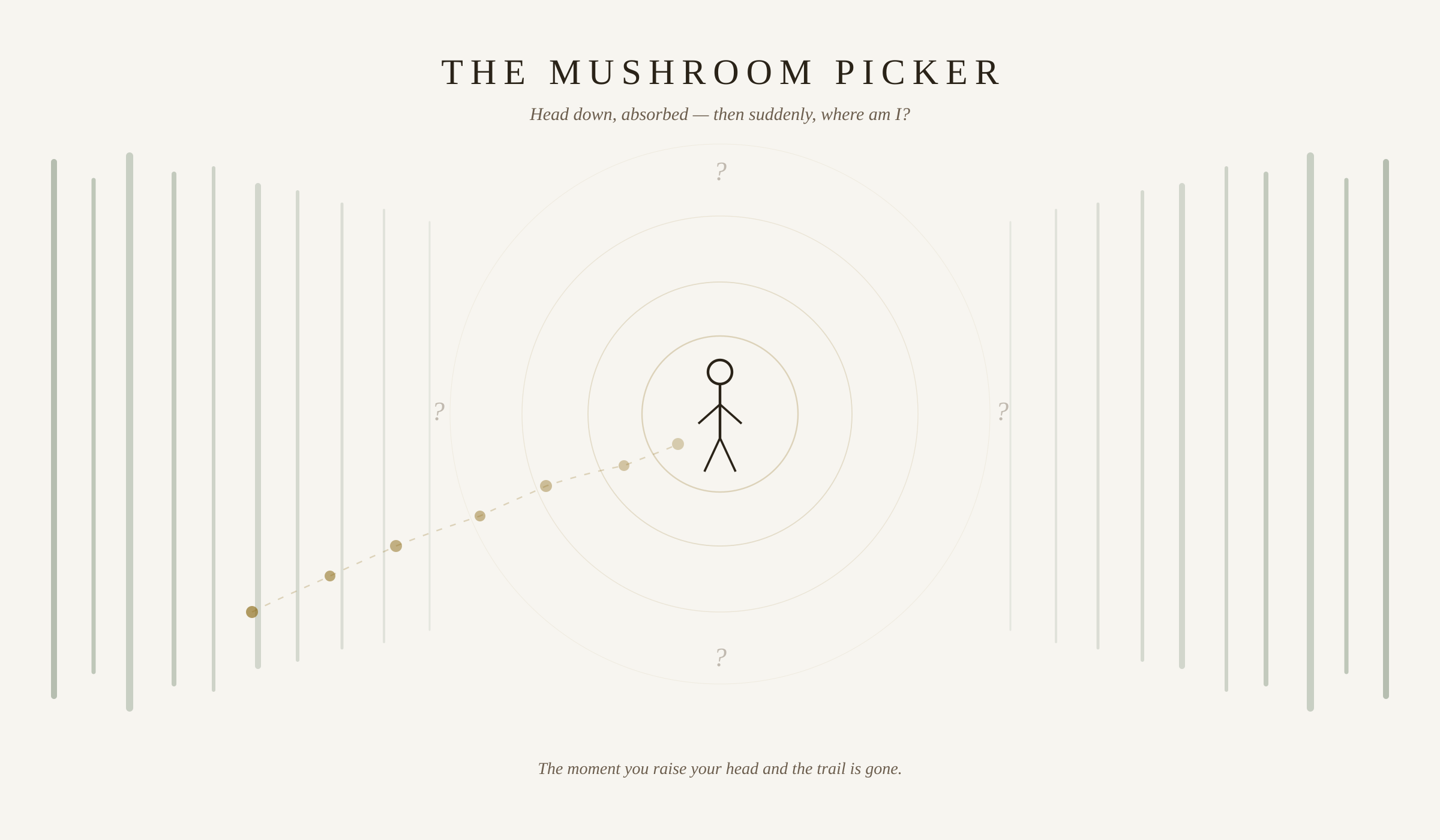
My mom was a perfect mushroom picker. We’d go to the forest and she would lead us in, completely absorbed. She’d spot a mushroom a couple of meters away and run toward it. Then she’d find another one, and another, eyes fixed on the ground, scanning and collecting, completely in flow. After a while something would stop her — the mushrooms ended, or the terrain changed — and she’d raise her head, look around, and realize she had no idea where she was.
That’s when the yelling would start. She’d call for my dad and me, and we’d call back, trying to help her orient. Eventually she’d find her way to us.
I think this is what happens to many of us. You’re the mushroom picker. You were absorbed in what was right in front of you — one thing after another, each one interesting or necessary or simply there — and then one day you raise your head and the trail is gone. You can see and name the things around you, but you don’t know how you got here. And figuring out how to get out is a completely different problem than figuring out what brought you in.
When the stakes are higher — and by now they usually are — there’s a specific kind of panic that sets in.
How did I get here? Every move feels consequential. Every direction looks risky.
You think: Okay, now I need to be deliberate. But you’re already in some form of crisis. And suddenly, because you’ve started actually paying attention, everything looks difficult. If you’re an overthinker, you see complexity everywhere you turn. You feel like any move is going to be a big one, and that can get you completely stuck.
On one hand, there’s more pressure than ever to make a decision. On the other, there’s this new inability to do so. You’ve entered editing mode — and editing is so much harder than generating. Up until now, you could add things to your life. Now you need to prune. You have to discard options. And that triggers loss aversion at a scale you haven’t experienced before.
For many of us, this is genuinely the first time we start making real choices. Not picking from a menu where everything looks appealing, but choosing at the cost of something else. And we live in a world that doesn’t really support that. We’re told we can have it all. We’re told to buy now, enjoy now, figure it out later. Scarlett O’Hara had it right in spirit — I’ll think about it tomorrow — except tomorrow has arrived and the bill is due.
If this sounds familiar - you’re in good company!
You’re just the mushroom picker who finally raised their head — and that moment, as disorienting as it is, is actually the beginning of something.
It’s just that what comes next isn’t what most people expect. It’s not a five-step plan or a vision board or a dramatic reinvention. But that’s for next time.
This is what I help people do — navigate the space between “this isn’t working” and “I know what’s next.” If you’re in that in-between and want to do this work with better tools and good company, I’d love to tell you about what I’m building. More on that soon.
I like how you named the one thing that everyone is doing and no one notices it's a problem. By naming it, we can now talk about it and work towards a solution. Nice!